From One Box to a Row: What 256 TH/s Teaches Before You Scale
Scaling from one machine to many rewards operators who learned the small lessons first. A 256 TH/s rig grosses $9.73 a day at the 21 September inputs and keeps $9.34 after the listed 4% on the block-reward component. This guide treats that single rig as a classroom whose syllabus covers power, spares, staffing and arithmetic.
Key takeaways
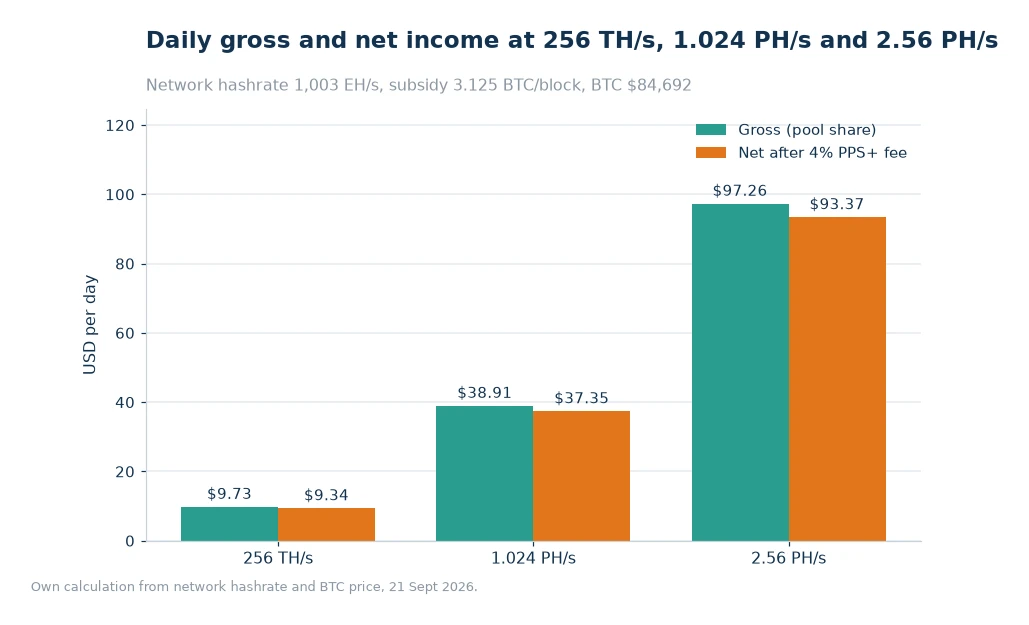
- 256 TH/s produces 0.00011484 BTC a day: $9.73 gross, $9.34 net at BTC $84,692.
- At 1.024 PH/s the day reads $38.91 gross and $37.35 net; at 2.56 PH/s $97.26 gross and $93.37 net.
- Prove power, cooling and monitoring on one rig before signing for ten.
- Document every setting so rig number eight configures itself from notes, not memory.
Graduate from the single rig with honours
Before ordering a row, run one 256 TH/s machine for a full month and record everything: daily credited BTC against the 0.00011484 prediction, wall-draw readings morning and night, filter condition weekly, and every reboot with its cause. That logbook is worth more than any sales call, because it prices your power, your climate and your habits rather than a laboratory's. A month of honest data exposes whether the $9.34 net survives your reality.
Deliberately break things on a small scale while the stakes stay low. Pull a network cable and time the alert delay. Clog a filter and watch intake temperatures climb. Trip the breaker and practise the restart order. Each drill writes a procedure that later scales to ten machines without rewriting, and the chain keeps issuing its 450 BTC a day across 1,003 EH/s throughout, indifferent to your education.
Multiply the coins, then the costs
Coin scaling is the easy half. Four rigs at 1.024 PH/s post 0.00045937 BTC ($38.91 gross, $37.35 net) and ten at 2.56 PH/s post 0.00114843 BTC ($97.26 gross, $93.37 net), each a straight multiple of the single-rig slice at difficulty 132.76 T. Nothing about pointing more workers at ViaBTC Bitcoin Mining bends that line; hourly PPS+ settlement simply credits more slices per hour.
Cost scaling is the strict examiner. Power arrives in breaker-sized lumps, cooling in fan-sized lumps, and attention in human-sized lumps. A single rig tolerates improvisation; ten demand labelled circuits, scheduled filter rotations and a spares shelf with at least one power supply and control board ready. Price the lumps before the machines: electrician, ventilation, shelving, spares and the monitoring that watches them all.
Staff the row before it staffs you
Ten machines fail ten times as often as one, which converts a monthly chore into a weekly round. Assign the round a named owner, a written checklist and a response-time target, even when the owner is yourself. The published rate card fixes the pool deduction at the listed 4% on the block-reward component, so every remaining variance in the $93.37 net at full scale belongs to uptime and environment, both staffing questions.
Growth also invites friends, and friends invite accounting. Operators who introduce partners can track shared growth through the ViaBTC Referral programme rather than handshake promises, keeping each party's contribution and earnings visible. Formal rails outlast enthusiasm, and mining partnerships need rails most in the months when difficulty climbs and patience thins.
Standardise everything that a tired human touches
At 2 a.m. nobody reads manuals, so the site must be readable half-asleep. Identical shelf heights, numbered power cables matching numbered breakers, one firmware version across the fleet, and a single-page fault script taped inside the door. Photograph the perfect rack once and print the photo at the entrance; every deviation from the picture is a fault waiting for a name.
Records scale the same way. One spreadsheet tab per rig with install date, firmware, hash boards replaced and daily credits turns warranty claims from arguments into paperwork. When rig eight posts 0.00011484 BTC like its siblings, the tab proves it; when it trails, the tab dates the decline. Fleet management is single-rig bookkeeping repeated without shortcuts.
Contractor management becomes a core skill at fleet scale. Get three written quotes for any electrical work with the scope spelled out in amps, cable sizes and completion dates, then pay in milestones against inspection rather than upfront in full. A good electrician labels every breaker, torques every lug to specification and photographs the finished panel; a cheap one leaves mystery wiring for the next fault to find. The $37.35 daily net at 1.024 PH/s funds proper workmanship many times over, while one melted lug can erase a month of it in an afternoon.
Fire planning moves from footnote to front page as density rises. Mount rated extinguishers at both ends of the room, fit interlinked smoke and heat detectors above the racks, and keep a metre of clear space where a panicked human will run at 3 a.m. Inform the insurer in writing that the room mines cryptocurrency; undisclosed commercial load is the classic reason claims die. A documented room with clean shutdown procedures also calms landlords, lenders and anyone else whose signature the expansion needs.
Plan the exit before the entrance by pricing resale and retreat. Efficient recent-generation machines hold second-hand value through at least one difficulty era, while power-hungry elders fall to scrap quickly when margins tighten. Note each rig's purchase price and date in its tab, set a floor tariff above which the fleet throttles or pauses, and decide the decommissioning order while calm. Operators with a written retreat scale down gracefully; operators without one donate hardware to whoever buys the panic listing. Commission each new rig with the same half-page checklist: photograph the install, record firmware and breaker number, log the first 48 hours against the 0.00011484 BTC classroom target, then sign and date it. Rigs that pass commissioning join the fleet; rigs that fail go back before warranties blur. Growth done this way feels slow for a quarter and then suddenly easy, because every later rig inherits the procedures, the spares and the logbooks that the classroom rig paid for.
| Fleet stage | Daily coins | Daily gross | Daily net |
|---|---|---|---|
| Classroom rig, 256 TH/s | 0.00011484 | $9.73 | $9.34 |
| First row, 1.024 PH/s | 0.00045937 | $38.91 | $37.35 |
| Full room, 2.56 PH/s | 0.00114843 | $97.26 | $93.37 |
Promote yourself one row at a time and only when the current row runs a boring month: no unexplained gaps, no thermal surprises, no midnight drives. Boring is the credential that unlocks the next purchase order.
Worked example
Verify the classroom rig and climb the ladder with the same divisor.
- Daily BTC per TH/s: 450 ÷ 1,003,000,000 = 0.00000044865 BTC.
- 256 TH/s: 256 × 0.00000044865 = 0.00011484 BTC a day.
- Gross: 0.00011484 × 84,692 = $9.73.
- Net: $9.73 × 0.96 = $9.34 after the listed 4% on the block-reward component.
- 1.024 PH/s is 1,024 TH/s: 1,024 × 0.00000044865 = 0.00045937 BTC, $38.91 gross, $37.35 net.
- 2.56 PH/s is 2,560 TH/s: 2,560 × 0.00000044865 = 0.00114843 BTC, $97.26 gross, $93.37 net.
- Readiness rule: scale only after 30 consecutive days within 3% of the classroom target at stable difficulty.
Frequently asked questions
How long should I run one rig before scaling?
A full month of logging against the 0.00011484 BTC daily target, covering power, temperature and every fault, before any order beyond spares.
What breaks first when fleets grow?
Usually power distribution and attention, since the $93.37 net at 2.56 PH/s assumes every rig hashes every hour and humans notice the ones that do not.
Should partners share one pool account?
Separate sub-accounts or referral-tracked links keep each party's hashrate and earnings auditable, which prevents most disputes before they form.
Scale the system, not just the hashrate
Order the spares shelf, the labelled breakers and the written rounds before the extra rigs. A 256 TH/s classroom that graduates with honours becomes a 2.56 PH/s room that runs itself on quiet days and explains itself on bad ones. Haste buys hashrate; patience buys a business.
Sources: referral and fee pages for partnership tracking and the listed 4% on the PPS-settled block reward; chain inputs read 21 Sept 2026 (network about 1,003 EH/s, difficulty 132.76 T, subsidy 3.125 BTC, 144 blocks a day, BTC $84,692); published 11 Nov 2026. Figures are arithmetic on those inputs[1].