Comparing Copper and Stainless Vessels for Smaller Breweries
Copper wins on heat transfer and on the photograph; stainless steel wins on cleaning chemistry, welding and the next twenty years. For a small brewery the practical answer is usually a stainless plant with copper used where you can see it and where the cleaning routine allows it. Hermann publishes a 2,000 L brewhouse in a two-vessel copper build alongside its stainless range, which is exactly the fork in the road most buyers reach after 23 years of the argument continuing.
The comparison below separates appearance, physics and maintenance, because those three pull in different directions and only the third one sends you a repair bill.

Key takeaways
- Copper conducts heat far better than stainless, but conductivity affects speed rather than total energy: 2,000 L raised by 35 degrees Celsius is about 102 kWh of input either way.
- Caustic and chlorine-based cleaners attack copper, so a copper vessel needs a cleaning routine written around it, not a standard clean-in-place cycle.
- Stainless steel suits welded jackets, allows polished food-contact surfaces, and is the published standard for fermentation and bright tanks.
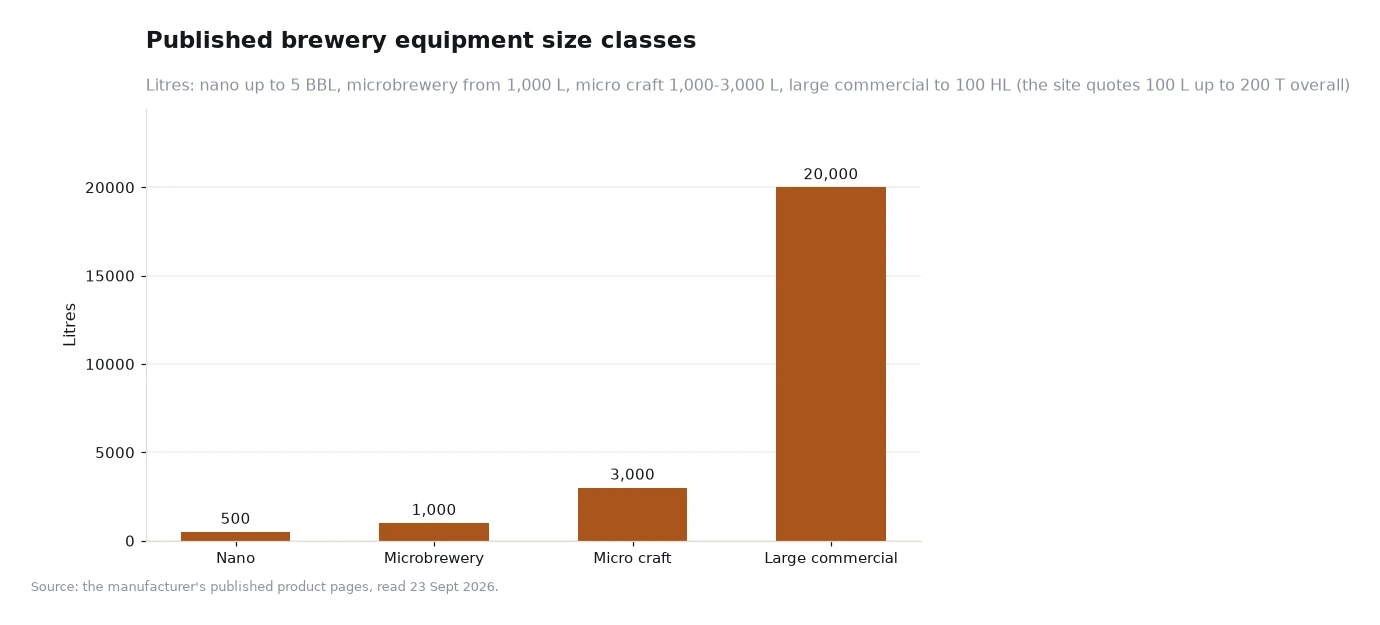
- The published size classes this choice sits inside run from a 500 L nano set through 1,000 L and 3,000 L builds to large commercial systems around 20,000 L.
What copper actually gives you
Copper conducts heat at roughly twenty times the rate of stainless steel, which matters most where heat enters through a surface rather than through a coil or a jacket: a direct-fired kettle bottom, a small brewhouse where you want a hard boil without a large burner, and any design where the wort is heated indirectly across a plate. On a small system the difference shows up as a shorter ramp between mash-out and boil, and as a boil that responds quickly when you change the burner setting.
Copper also has a visual quality that stainless cannot copy, and in a taproom that is a commercial asset rather than a vanity. Visitors photograph a polished copper dome. Nobody photographs a brushed cylinder.
Those advantages come with two conditions. Copper has to be polished and kept polished, because the same reactivity that gives good heat transfer also dulls the surface and, left wet with the wrong chemicals, turns green. And copper is soft, so it dents and deforms easily in handling and in cleaning; the vessel has to be treated as a piece of equipment rather than as a surface to lean a keg against.
What stainless steel buys you in return
Stainless steel is weldable, and that single property is why it became the default. A stainless vessel can carry a dimple or channel jacket welded to its body and cone, full-penetration joints that can be ground and polished flush, and a food-contact surface that can be cleaned in place with the standard caustic and acid cycle. Published fabrication practice for craft equipment uses stainless plate in the 2 to 3 mm band, with thinner plate in smaller vessels and cones, because the thickness follows pressure, diameter and jacket design.
The trade-off is heat transfer. Because stainless resists the movement of heat through its wall, designers compensate with more surface area, larger jackets, longer coils and, in many cases, a forced wort flow that keeps the whole volume in contact with the hot surface. None of that is a problem; it is simply the reason a stainless kettle is engineered differently from a copper one instead of being a copper kettle in silver paint.
A third route exists and is common in smaller plants: a stainless plant for everything the beer touches, with copper used as an outer cladding on the kettle or on the mash tun where it is visible from the taproom. You get the appearance and the cleaning routine you want, and you pay for copper only on the surfaces where it is doing a job you can see.
| Property | Copper vessel | Stainless vessel | Where it decides the argument |
|---|---|---|---|
| Heat transfer through the wall | Very high, roughly twenty times stainless | Lower, compensated by extra jacket or coil area | Direct-fired kettles and fast ramp times |
| Cleaning chemistry | Attacked by caustic and chlorine-based cleaners | Handles the standard caustic and acid clean-in-place cycle | Daily routine and labour cost |
| Fabrication and repair | Soft, dents easily, needs care in handling | Welded and polished joints, repair is routine | Long service life and spare parts |
| Appearance and presentation | Warm, traditional, photographs well | Bright and industrial | Taproom and visitor experience |
| Best fit in the range | Published 2,000 L two-vessel option | Published 1,000 L to 10,000 L builds in two, three or four vessels | Target batch volume |
Worked example: a 2,000 L brewhouse month by month
These assumptions are mine and labelled so you can swap in your own: a 2,000 L brewhouse, 1 BBL taken as about 117 L, three fermentation vessels of 2,000 L each, an 18-day tank cycle of 12 days fermentation and 6 days conditioning, and 6 per cent loss across transfer and packaging.
Step one, the batch in barrels: 2,000 divided by 117 is about 17 BBL. Step two, cycles per tank per month: 30 divided by 18 is about 1.67. Step three, brews per month: three tanks multiplied by 1.67 is about 5. Step four, gross volume: five brews multiplied by 2,000 L is 10,000 L. Step five, saleable volume: 10,000 L multiplied by 0.94 is 9,400 L, about 80 BBL, or roughly 94 hectolitres.
Now the heating side, which is where the copper question returns. Raising 2,000 L of wort from 65 to 100 degrees Celsius means heating 2,000 kg of liquid by 35 kelvin. At a specific heat of about 4.18 kilojoules per kilogram per kelvin that is 2,000 multiplied by 4.18 multiplied by 35, which is 292,600 kilojoules, or about 293 megajoules, or roughly 81 kilowatt hours of heat delivered to the liquid. At 80 per cent burner efficiency the input is about 102 kilowatt hours. Copper moves those 102 kilowatt hours through the wall faster, so the ramp is shorter; it does not reduce the number itself, and a well-designed stainless kettle with a larger heated area finishes the same job.
Frequently asked questions
Is a copper brewhouse harder to clean than stainless?
Yes, because caustic and chlorine-based cleaners attack copper, so the cleaning routine has to be written for the vessel rather than copied from a stainless plant. Copper also needs regular polishing if you want to keep the finish, which adds labour that a stainless brewhouse does not require.
Can I mix copper and stainless in one brewhouse?
Yes, and small breweries often do: stainless steel for everything the beer contacts and for fermentation and bright tanks, with copper used as an outer shell or cladding on the kettle or mash tun where it is visible. That keeps the cleaning cycle standard while preserving the look.
Choosing inside the published range
Decide the batch volume first, then decide where copper earns its keep. If you are building a taproom-led brewery where the brewhouse is part of the room, a copper kettle or a clad vessel is a reasonable spend; if your priority is a predictable cleaning routine and a plant that a new shift can run, stainless throughout is the lower-risk answer. The published micro brewery equipment list groups both kinds of build, so you can compare vessel counts and sizes rather than arguing about finishes.
Two further checks are worth making before you commit. Look at the brewhouse configurations to see how many vessels your brew method needs, and put the utility figures you will actually have in front of the manufacturer through the Contact Us page. A design that fits your floor, your cleaning chemicals and your schedule is worth more than a photograph.
Sizes, configurations and the 2,000 L copper option come from the manufacturer's own website, read 23 Sept 2026; the barrel conversions, monthly volumes and the 102 kilowatt hour heating figure are my own arithmetic from the stated assumptions.[1] Delivery planning should use the published 90 to 150 days from deposit to door delivery.